John Douglas Finally Proposes to Janet Sweet
Anne of the IslandJohn Douglas’s proposal to Janet Sweet, made just after his mother’s death, resolves a courtship held in silence for nineteen years. The proposal reveals that the delay was not a sign of indifference: John had been bound by a promise to his mother, while Janet had waited without knowing why. Their reunion brings happiness, but Janet’s decision to keep the explanation private makes forgiveness, rather than public vindication, the event’s final emphasis.
The Death That Ends the Delay
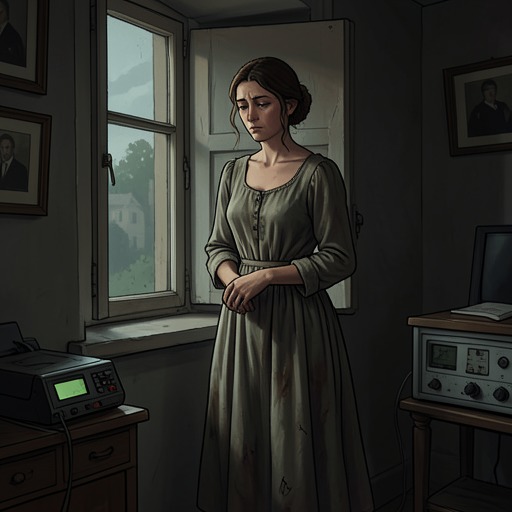
Janet comes home in the twilight after visiting Mrs. Douglas and tells Anne Shirley that the older woman has died soon after Janet arrived. Mrs. Douglas spoke to Janet once, asking whether she would marry John now. The question wounds Janet because it suggests that Mrs. Douglas believed she had withheld marriage out of hostility toward her. Janet had no chance to answer: other women were present, and John had gone out. The death therefore removes the obstacle to the marriage while leaving Janet with fresh hurt and no explanation of the history behind it.
Anne tries to comfort Janet with a hot drink, mistakenly using white pepper instead of ginger. The small, misguided kindness precedes the larger scene of emotional disclosure: Anne can offer companionship, but she cannot yet tell Janet why the courtship has stalled. On the evening after the funeral, the two sit together on the front porch steps. Janet is still grieving and does not welcome Anne’s attempts to cheer her. Her mood is not a simple anticipation of freedom after Mrs. Douglas’s death; grief and the unresolved strain of the visit remain present when John arrives.
The Proposal and Its Explanation
John enters the garden and walks straight across the geranium bed toward Janet. Anne rises too, but although she is tall and dressed in white, John does not notice her. His attention is fixed on Janet. He asks her to marry him with an urgency that makes the proposal seem long overdue: the words appear to have been waiting to be spoken for twenty years and to demand release at once. The request changes the scene from a quiet evening after a funeral into the long-awaited turning point in their relationship.
Janet asks why he did not ask sooner. John explains that, nineteen years earlier, his mother suffered a serious illness and was not expected to live long. During that crisis, she made him promise not to ask Janet to marry him while she was alive. He did not want to make the promise, but his mother insisted, and he agreed. The doctor had given her only six months, yet she lived on and continued to hold him to his word. John says that he had repeatedly pleaded with her to release him, but the promise remained in force.
The impediment, John tells Janet, was not any objection to her personally. His mother did not want another woman in her son’s life while she was living. She made the promise a condition of her own security, and John understood himself to be bound by it. The revelation overturns Janet’s understanding of the long wait: she had experienced the silence as an unexplained barrier, while John had experienced it as an obligation he was forbidden even to disclose.
A Secret Between the Two of Them
John had not merely avoided explaining himself. He says his mother made him promise not to tell anyone and swore him to secrecy on the Bible. He regrets that he could not foresee how long the restriction would last, and acknowledges that the years have caused Janet suffering as well as his own. His explanation thus accounts for both the proposal’s suddenness and the absence of any earlier account from him: with his mother dead, he can finally ask, but he can only now tell Janet why he waited.
Janet’s face is still reddened from crying when she asks why he did not tell her, and her response makes clear how much the silence mattered. She accepts the explanation, but the scene does not turn her earlier hurt into something insignificant. Instead, she recognizes that she would have found the waiting bearable had she known its cause. John’s account supplies the missing knowledge; it cannot give those years back. Anne, who has witnessed the exchange, realizes she should leave and slips away before seeing what follows.
The next morning, Janet tells Anne the rest. She is happy at last, but refuses to speak ill of Mrs. Douglas now that she is dead. Anne calls the older woman cruel and deceitful; Janet counters that death changes what may properly be said about her. Her restraint does not deny that the promise harmed the couple. It distinguishes her private knowledge of what happened from the public judgment she is willing to make of John’s mother.
Marriage, Privacy, and Forgiveness
Janet and John plan to marry the following month, quietly. Janet expects people to gossip that she hurried to marry John as soon as his mother was gone. John wants the truth made known, but Janet persuades him to keep it between them, so that no shadow falls on his mother’s memory. She accepts that others may misunderstand the timing because, now that she knows the reason for it, their opinions matter less to her. She wants the story buried with the dead rather than used to condemn them.
Anne tells Janet that she is more forgiving than Anne could be. Janet answers that forgiveness becomes easier with age, contrasting how it feels at forty with how it feels at twenty. The exchange gives the resolution a generational perspective: Anne sees the injustice and wants it named, while Janet, who bore its consequences, chooses not to expose the secret. The proposal delivers the marriage they had been denied, but the ending is not a public correction of the past. It is a private reconciliation, secured by knowledge at last and sealed by Janet’s choice to forgive.